Server Error Cannot Load the Stats for Reactnativeelements – Please Try Again Later
React Native Elements four.0
·
three min read

React Native Elements v4 introduces many features including few new components, fully typescript support and some breaking changes whose migration is beingness given below.
To use the v4 version, y'all first need to update the bundle names:
                                                      -                                          import {} from 'react-native-elements'
                                                                            +                                          import {} from '@rneui/themed'
You can install the packages from npm or yarn
                                                      npm                                                            install                                          @rneui/base @rneui/themed

                                                                            # or with yarn
                                                                            yarn                                                            add                                          @rneui/base @rneui/themed
You can too make alias for parcel to help you with migration.
yarn add react-native-elements@npm:@rneui/themed
Colors
Added a new background color to the colors object.
                                                      const colors={
                                                                                                                                          primary: '#2e7d32',
                                                                                                                                          secondary: '#757575',
                                                                            +                                          background: '#ffffff',
                                                                            }
Theme
                                                      const theme:FullTheme={
                                                                                                                                          colors:{},
                                                                            +                                          spacing:{}
                                                                            }
Pressable
These components are now using Pressable instead of Touchable
- Avatar
- Bluecoat
- ButtonGroup
- CheckBox
- Icon
- Image
- ListItem
- SearchBar
- SpeedDial
- Tile
Pressable is a Core Component wrapper that can observe various stages of press interactions on whatever of its divers children.
This modify would let you use onPressIn & onPressOut APIs in components, For case
                                                                                                                    <CheckBox
                                                                                                                                          title="I agree"
                                                                                                                                          onPress={()=>{}}
                                                                                                                                          onLongPress={()=>{}}
                                                                            +                                          onPressIn={()=>{}}
                                                                            +                                          onPressOut={()=>{}}
                                                                                                                                          onPress={() => {}}
                                                                                                                                          />
and the rest of props for Pressable can be added via pressableProps API
                                                                                                                    <ButtonGroup
                                                                            +                                          pressableProps={{android_ripple:{radius:ii}}}
                                                                                                                                          />
few other props (like underlayColor) will not be supported, you can remove them.
Button
                                                                                                                    <Button
                                                                            +                                          size='sm',
                                                                            +                                          radius='dr.'
                                                                            +                                          color='primary'
                                                                            -                                          title='Press me'
                                                                            -                                          />
                                                                            +                                          >
                                                                            +                                          Press me
                                                                            +                                          </Button>
ThemeProvider
Please make certain that ThemeProvider is divers at the root of your application (even if you are using the default theme) and NO useStyles or useTheme is chosen before <ThemeProvider>
                                                      -                                          <ThemeProvider theme={myTheme} useDark={false}>
                                                                            +                                          <ThemeProvider theme={myTheme}>
                                                                                                                                          <Button championship="My Button" />
                                                                                                                                          </ThemeProvider>
Create custom theme using createTheme helper
                                                      -                                          const myTheme: FullTheme = {
                                                                            +                                          const myTheme = createTheme({
                                                                            -                                          colors: {
                                                                            +                                          lightColors:{
                                                                                                                                          primary: '#f2f2f2',
                                                                                                                                          },
                                                                            +                                          darkColors: {
                                                                            +                                          primary: '#121212',
                                                                            +                                          },
                                                                            +                                          mode: 'dark',
                                                                            };
Since useDark is deprecated, you can switch dark and low-cal themeColors using updateTheme function which tin can be access from useTheme hook.
Complete example of root of our application
                                                      import                                                            {                                          ThemeProvider                    ,                                          Button                    ,                                          createTheme                                        }                                                            from                                                            '@rneui/themed'                    ;

                                                                            const                                          myTheme                                        =                                                            createTheme                    (                    {
                                                                                                lightColors                    :                                                            {
                                                                                                primary                    :                                                            '#f2f2f2'                    ,
                                                                                                }                    ,
                                                                                                darkColors                    :                                                            {
                                                                                                primary                    :                                                            '#121212'                    ,
                                                                                                }                    ,
                                                                                                style                    :                                                            'dark'                    ,
                                                                            }                    )                    ;

                                                                            const                                                            App                                                            =                                                            (                    )                                                            =>                                                            {
                                                                                                return                                                            (
                                                                                                <                    ThemeProvider                                                            theme                    =                    {                    myTheme                    }                    >
                                                                                                <                    Button                                                            title                    =                    "                    My Button                    "                                                            />
                                                                                                </                    ThemeProvider                    >
                                                                                                )                    ;
                                                                            }                    ;
You tin can use props for components while defining themes
                                                      import                                                            {                                          createTheme                                        }                                                            from                                                            '@rneui/themed'                    ;

                                                                            const                                          myTheme                                        =                                                            createTheme                    (                    {
                                                                                                Push button                    :                                                            (                    buttonProps                    )                                                            =>                                                            (                    {
                                                                                                titleStyle                    :                                                            {
                                                                                                colour                    :                                          buttonProps                    .                    blazon                                        ===                                                            'solid'                                                            ?                                                            'bluish'                                                            :                                                            'red'                    ,
                                                                                                }                    ,
                                                                                                }                    )                    ,
                                                                            }                    )                    ;
Thus when we use type='solid' in Button component, it will use titleStyle will have "blueish" color.
Refer to Customization for more details.
Tooltip
Tooltip is one of core component of RNE, Since v4 this component would be stateless and would utilize visible, onOpen & onClose Props for its working.
                                                                                                                    <Tooltip
                                                                            +                                          visible={open}
                                                                            +                                          onOpen={() => {
                                                                            +                                          setOpen(true);
                                                                            +                                          }}
                                                                            +                                          onClose={() => {
                                                                            +                                          setOpen(false);
                                                                            +                                          }}
                                                                                                                                          popover="Hey All"
                                                                                                                                          />
You can nevertheless use Tooltip as stateful component by doing:
                                                      const                                                            ControlledTooltip                    :                                                            React                    .                    FC                    <                    TooltipProps                    >                                                            =                                                            (                    props                    )                                                            =>                                                            {
                                                                                                const                                                            [                    open                    ,                                          setOpen                    ]                                                            =                                                            React                    .                    useState                    (                    false                    )                    ;
                                                                                                return                                                            (
                                                                                                <                    Tooltip
                                                                              visible                    =                    {                    open                    }
                                                                              onOpen                    =                    {                    (                    )                                                            =>                                                            {
                                                                                                setOpen                    (                    truthful                    )                    ;
                                                                                                }                    }
                                                                              onClose                    =                    {                    (                    )                                                            =>                                                            {
                                                                                                setOpen                    (                    false                    )                    ;
                                                                                                }                    }
                                                                                                {                    ...                    props                    }
                                                                                                /                    >
                                                                                                )                    ;
                                                                            }                    ;
Google Summertime of Lawmaking'21 Arpit Bhalla
·
4 min read


-
Organization: React Native Elements
-
Project: Migrating Hooks, Tests & APIs
-
Mentors: Jeremy Hamilton, Pranshu Chittora, Dhruvdutt
-
Educatee: Arpit Bhalla
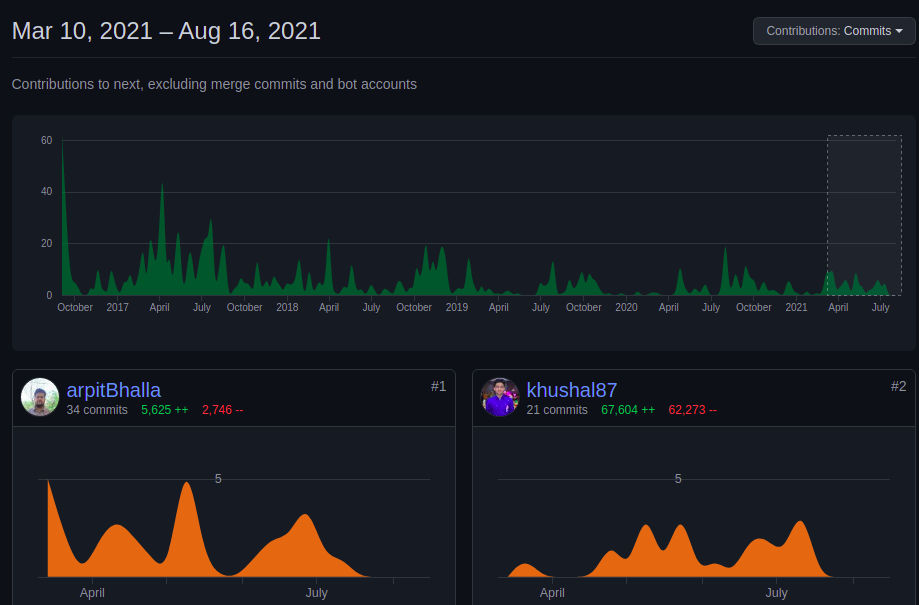
The Google Summer of Code 2021 has been a fantastic and cheerful learning feel for me over the past few months. I have learned a lot from the community, peculiarly how to organize commits and write readable lawmaking. React Native Elements is an amazing community to work with, every bit mentors are actually helpful and experienced. I had started contributing to React Native Elements from March 2021 and till at present, I have xl+ commits (10,803 additions and 13,826 deletions) merged. Over the past few months, I had great exposure writing maintainable code, communicating with the mentors, etc. I had completed some of my work in the coding catamenia started as some issues mentioned in my proposal had a high priority for the release.
Refactor components to use Pressable API (#3170)
Pressableis preferred toTouchablecomponents according to React Native official docs.Pressablecomponent offers a more than extensive and futurity-proof way of handling the touch on-based inputs.
-
TouchableComponent:- It includes the styles and effects that practice not run into the platform interactions.
- Information technology does not support high-quality interaction feel on different platforms.
-
PressableComponent:- It detects various types of interactions.
- Its API provides direct access to the current state of interaction.
- Its capabilities could be extended to include hover, blur, focus, and more.
Pressablecontains a lot of new props and cool features such equally: delayLongPress: Duration in milliseconds from onPressIn by the time onLongPress is called.
Reference : Pressable vs. Touchable in React Native
Migrate Tests to React Native Testing Library (#3170)
Rather than tests focusing on the implementation (Enzyme), tests are more focused on user behavior (react-native-testing-library).
Enzyme allows us to access the internal workings of your components. Yous tin read and set the country, and we can mock children to brand tests run faster. On the other hand, RN testing-library doesn't give united states of america whatever access to the implementation details. Information technology renders the components and provides utility methods to interact with them. The idea is that y'all should communicate with our awarding in the same way a user would. And then rather than set the state of a component nosotros reproduce the deportment a user would do to reach that country.
Course to Functions Migration
Some components like Image, ToolTip which further include SearchBar android & SearchBar iOS were Grade Components and the code was messy, These are migrated to Functional Components and added hooks like, useState, useEffect, useCallBack, which would increase operation.
- Using classes - We need to draw lifecycle methods, country of the component, component'due south methods that will change our state or work with the shop. Besides, we need to bind all the methods for the component instance. The component becomes large, and information technology becomes more than difficult to read each time.
- Using hooks - We can get the state of the component so that it can exist easily tested and reused. At present we tin can facilitate the exchange of links betwixt components or our entire application - using hooks. Hooks permit you lot to encapsulate logic without affecting the hierarchy of components.
You can notice all my contributions here
New components
- LinearProgress (#2867)
- FAB (#2885)
- Speed dial (#2896)
- Tab & TabItem (#2919)
- CircularSlider (#1)
- TabView & TabView.Detail (#2983)
- ListItem Piano accordion (#2953)
- ListItem Swipeable (#2982)
Core Improvements
- Drift build to Github Actions (#3101)
- Strict TypeScript (#2930)
- Removed ts-ignore and transformed to Functional Component (#2834)
Documentation redesigned (#3108)
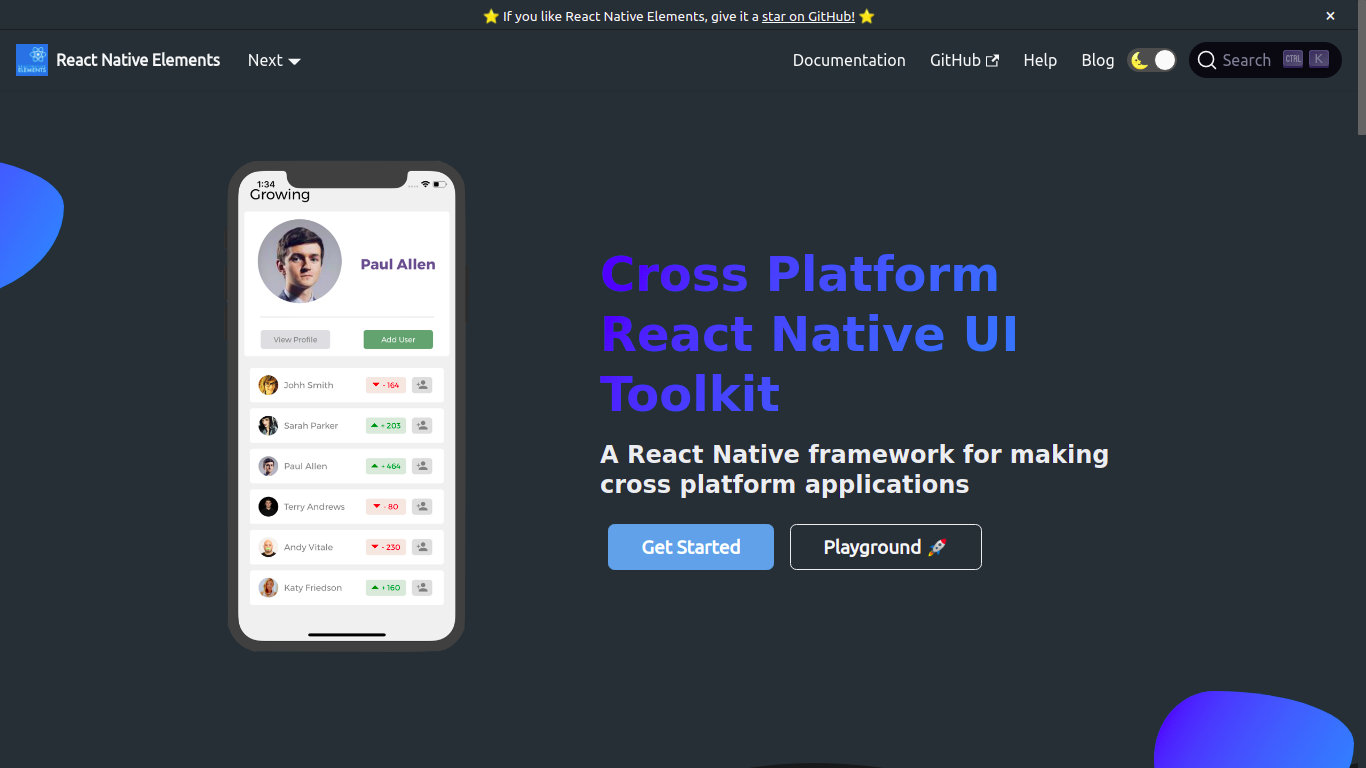
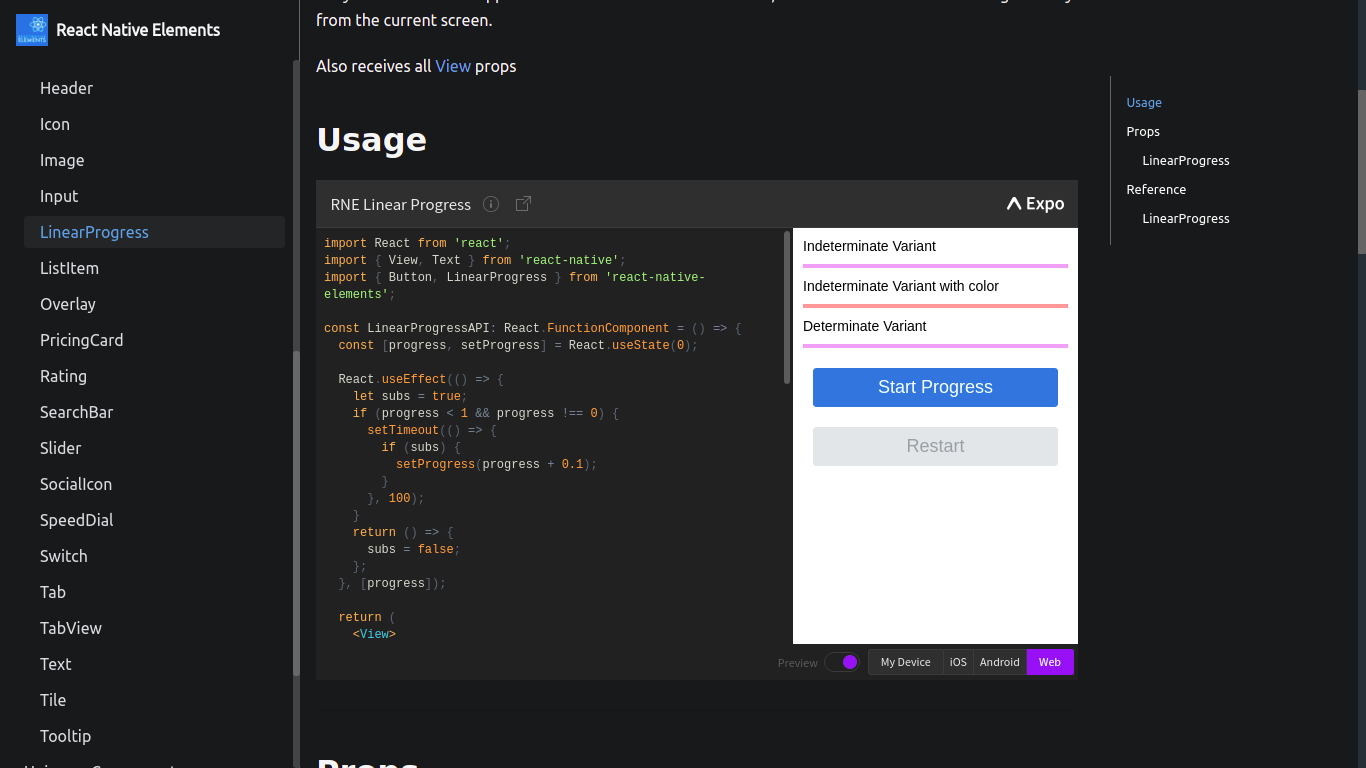
Snack player
It helps user to exam the component from documentation
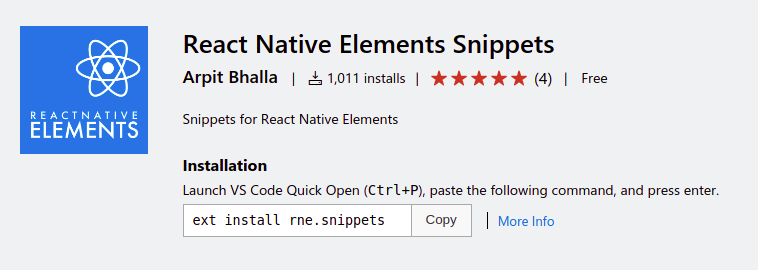
VS Code extension
Automobile imports components and automobile complete syntax with component preview for React Native Elements.
New Stack Component
Stack is concerned with one-dimensional layouts. This is non however in the priority but information technology would help developers.
Case
                                                      <                    Stack                                          spacing                    =                    {                    ii                    }                    >
                                                                                                <                    Item                    >                    Item                                                            1                    <                    /                    Particular                    >
                                                                                                <                    Detail                    >                    Item                                                            2                    <                    /                    Particular                    >
                                                                                                <                    Item                    >                    Item                                                            3                    <                    /                    Item                    >
                                                                            <                    /                    Stack                    >
Google Summer of Code'21 Khushal Agarwal
·
4 min read

Automatically generate documentation out of React/React Native Component
This summer, I was pleased to get selected for Google Summer of Code'21 nether the organization React Native Elements. Working under the organization, my project was to generate documentation automatically out of the UI components and present it in the Docusaurus website.

The purpose of creating this repository is to maintain a report summary of my GSoC work and this may also serve every bit a guide for future GSoC aspirants and a reference to the developers and contributors to the project.
React Native Elements is a cross-platform UI toolkit congenital on/for React Native. With a weekly download by 90k+ users and backed by a huge community, it provides UI components that tin be used in your native application for the platform of Android/iOS/Spider web.
The documentation of the project was maintained manually previously i.e., suppose I want to change/add/remove a prop or a new component to the projection the markdown file had to be changed manually. The process is tiring and new contributors may ofttimes forget to do so. And so, during the summers I took the alter this procedure and brand a workflow such that the generation is automatic. This should be fast and maintainable.
The deliverables of the project are as follows:
- Efficient Development Setup
- Re-structure and Refactor code to have a common pattern.
- Maintain the Usage/Examples of the component equally they are needed to be updated manually.
- Refactor and rename the directory construction such that Autogen is successful.
- Convert the code-base to take all the functional components.
- Commenting on all the components and props.
- Adding descriptions.
- Adding prop descriptions.
- Ensuring a common pattern is followed.
- Writing scripts to excerpt data out(in JS/TS) of it in the form of JSON.
- Converting the JSON information to Markdown.
- Automating the process such that the workflow works automatically whenever at that place is a change in the prop/definition or component code.
All of the listed deliverables were completed within the GSoC period. 🎉
The work can be found here - Official Website of React native elements. Please refer to the component docs.
I have also written a blog on how information technology works attached here.
Pull requests
| PR Link | Description | Status |
|---|---|---|
| #3071 | [Refactor] Documentation directory construction | Merged ✅ |
| #3081 | [Refactor] Directory structure of components | Merged ✅ |
| #3112 | [Add together] props clarification, descriptions to the component. | Merged ✅ |
| #3126 | [Docs] Added demos and snack for the documentation | Merged ✅ |
| #3136 | [Add together] Docgen auto generation of docs scripts | Merged ✅ |
| #3142 | [Docs] Added generate-markdown scripts | Merged ✅ |
| #3143, #3144 | [Fix] Problems related to automobile-generation of documentation | Merged ✅ |
| #3145 | [Fix, Meliorate] Doctor-gen issues and automation | Open(to be merged) 🕒 |
Issues
| Outcome link | Clarification |
|---|---|
| #3171 | [Docs] Auto-generation of documentation for course based components |
Apart from these contributions, I have contributed to other React native elements projects. They can be summarized every bit:
- Pull requests
- Issues
| Projection | Reference |
|---|---|
| React Native Elements - principal repo | Pull requests |
| React Native Elements App | Pull requests |
| Playground | Pull requests |
I would like to thank my mentors for helping me attain this milestone. 😄😄
I have not only learned almost the Open Source civilisation and how to write expert lawmaking but also, learned how the industry works and the import
- Dhruvdutt Jadhav - GitHub. LinkedIn
- Pranshu Chittora - GitHub. LinkedIn
- Jeremy Hamilton - GitHub. LinkedIn
I would likewise like to give thanks Arpit Bhalla for existence an amazing partner in this amazing journeying.
Automobile-generation of Documentation Website
·
4 min read
This is a guide to generate documentation of the UI components automatically.
Initially when this workflow was non nowadays, the entire documentation of the website was done by editing the docs manually past going to the docs directory under website and editing the markdown manually. Now, nosotros have come with a flow where developers and contributors can focus more on logic than on writing markdown.
To do this we have created scripts which would parse the components and generate documentation out of it.
This is a 2 footstep process:
-
We take utilise of
react-docgen-typescriptwhich takes the input of the files for which we want to generate the documentation automatically. This gives in JSON as output. This JSON consists of all the details of the props includingtype,proper name,descriptionanddefaultValueand well asdescriptionof the components. -
As we utilise Docusaurus for our documentation website, the pages of the documentation should be in the format of Markdown. Therefore, at that place should be process where we can change the JSON data, which nosotros get from
react-docgen-typescriptto a suitable Markdown format. For this we apply,json2mdwhich takes in the data and convert information technology to suitable markdown cord. This is stored in the directory and is shown on the website.
How does this work
Well to brand the script to work automatically what we have done is as follows:
-
When you push button your changes to your co-operative. A script
updateDocumentation.jsruns. -
This invokes the
yarn docs-buildcontrol which calls the scripts of auto-generation of docs and this also lints the markdown files generated at the same time. -
Now, if there is any changes in the markdown files. A commit with message
Update Documentationis done and pushed later your commit is done to the branch.
Notation: By passing pre-push hook will effect in failure of documentation update and may lead maintainers to shut your PR.
This is simple. Calculation, removing, updating the props is besides simple at present. You lot just need to update the comments/description of the component and deal with the logic of your React Components(if required). Our workflow will automatically observe the markdown changes if any and push the changes using pre-push hooks while you push your code to your co-operative.
Trust me this is piece of cake. Nosotros have designed the workflow such that, y'all merely need to work on your JavaScript/TypeScript logic, without bothering most updating the markdown files. The input to the docgenParser is automatic and doesn't require any aditional cofiguration.
Make sure to add appropriate comments and description related to the components and the props of the component. Try keeping your lawmaking simple with simpler types for Autogen to work.
Please note: The file name of the component besides as the folder must be in Uppercase letter. We use regex to parse the file paths, so this is of import.
Annotation: If at that place are complex types/defaultValue, please head to website/scripts/docgen/docgenParser.ts to deal with those cases. Although we recommend you lot to avoid it as far as possible. Try improving the React logic and that volition work.
The demos can now be added by moving in to the usage directory nether website/docs/chief directory. We now have added Snack Player so that y'all get the glimpse of the component and as well go to know how information technology works. Nether the usage, there is a carve up folder for each UI Component, where you lot can add together Usage related to component and relevant descriptions.
Note: To add Snack demo, add it inside the snack directory. You can add together every bit many Snack which will make our repository more helpful for developers.
For testing the changes in the documentation autogeneration, we simply demand to run the following commands in sequence.
We have also included the changes in the main test process, so this will automatically run with the workflow every bit well as when y'all run the yarn test command from root of the project.
Some of the components are class-based. They are: Input, SearchBar, Rating.(from https://github.com/Monte9/react-native-ratings). If you modify the components to Functional/hooks based please remove it from the array of filesToExclude under website/scripts/docgen/getComponentFiles.ts. These are the paths of the component files for which the process is nevertheless transmission.
So, generating the documentation doesn't come up well for these components. Due to the existing structure react-docgen-typescript fails to generate relevant result for them. We are therefore looking for contributions on these components to make them Fuctional/Hooks based.
Thanks. Hope you lot like the new workflow. Looking forward for improvements and contributions to it.
Version 2.3 Upgrade Guide
·
4 min read
At that place take been a lot of changes and improvements coming through the pipeline recently with react-native-elements. Then in preparing for a version three, there are some planned deprecations that will be added into version ii.3 and then removed in version three.
The reason for these changes is that react-native-elements regularly gets requests for new features and enhancements quite frequently. The fast and easy method of adding these new features is usually to add another prop into the component that so injects some alter into a child component. Unfortunately, this ends up leading to the components having a lot of props, lots of conditional code, and additional code complexity. The solution going forward and into version 3 volition be to break downwards large components into smaller pieces so that it is easier to inject your ain lawmaking without having to wait for an additional prop to exist added.
As we continue to build up to version 3, this post volition continue to be updated with new footstep-by-step directions on how to upgrade your lawmaking to piece of work around these changes. The RNE team thanks you for your patience, and we hope that you see the value in the upcoming changes.
accessory, showAccessory, and accessoryProps are all being dprecated. There is now a child component Avatar.Accessory that you insert equally a kid component instead.
                                                      <                    Avatar                    >
                                                                                                <                    Avatar                    .                    Accessory                                                            {                    ...                    accessoryProps                    }                                                            /                    >
                                                                            <                    /                    Avatar                    >
ListItem has a large number of deprecated props. ListItem has been somewhat of a kitchen sink. All the props can be replaced by inserting them every bit children in the order of left to right as they appear on the screen.
leftElement, leftIcon, leftAvatar, rightElement, rightIcon, rightAvatar
These can be replaced by using Text, Icon, and Avatar components respectively.
title, titleStyle, titleProps, subtitle, subtitleProps, subtitleStyle
These props can be replaced by ListItem.Content, ListItem.Title and ListItem.Subtitle
                                                      <                    ListItem                    >
                                                                                                <                    ListItem                    .                    Content                    >
                                                                                                <                    ListItem                    .                    Title                                          manner                    =                    {                    titleStyle                    }                                                            {                    ...                    titleProps                    }                    >
                                                                                                {                    championship                    }
                                                                                                <                    /                    ListItem                    .                    Title                    >
                                                                                                <                    /                    ListItem                    .                    Content                    >
                                                                            <                    /                    ListItem                    >
contentContainerStyle, rightContentContainerStyle
These props should be placed in the manner prop of ListItem.Content.
rightTitle, rightTitleStyle, rightTitleProps, rightSubtitle, rightSubtitleStyle, rightSubtitleProps
These props too utilise ListItem.Content, ListItem.Championship, and ListItem.Subtitle. Merely add together the prop right to each one.
                                                      <                    ListItem                    >
                                                                                                <                    ListItem                    .                    Content                                          right                    >
                                                                                                <                    ListItem                    .                    Championship                                          correct style                    =                    {                    titleStyle                    }                                                            {                    ...                    titleProps                    }                    >
                                                                                                {                    title                    }
                                                                                                <                    /                    ListItem                    .                    Title                    >
                                                                                                <                    /                    ListItem                    .                    Content                    >
                                                                            <                    /                    ListItem                    >
input, buttonGroup, switchProps, checkBox, badge, chevron, checkmark
The input prop can be replaced with ListItem.Input.
The buttonGroup prop tin be replaced with ListItem.ButtonGroup.
The switchProps prop tin be replaced with react-native'due south Switch.
The checkBox prop can be replaced with ListItem.CheckBox.
The badge prop can be replaced with Badge.
The chevron prop tin be replaced with ListItem.Chevron.
The checkmark prop can be replaced with :
< Icon name = "check" size = { xx } / >
For Carte du jour the following props have all been deprecated: title, titleStyle, titleNumberOfLines, dividerStyle, image, imageStyle, imageProps, imageWrapperStyle, featuredTitle, featuredTitleStyle, featuredSubtitle, featuredSubtitleStyle
title, titleStyle, titleNumberOfLines
Move these props into Card.Title
                                                      <                    Menu                    >
                                                                                                <                    Card                    .                    Title                                          style                    =                    {                    titleStyle                    }                                          numberOfLines                    =                    {                    titleNumberOfLines                    }                    >
                                                                                                {                    title                    }
                                                                                                <                    /                    Card                    .                    Title                    >
                                                                            <                    /                    Bill of fare                    >
dividerStyle
The divider and the dividerStyle itself were moved into Carte du jour.Divider
image, imageStyle, imageProps, imageWrapperStyle
These can be replaced with Bill of fare.Image which accepts all Prototype props. imageWrapperStyle can exist attached to a View that wraps the Prototype
featuredTitle, featuredTitleStyle, featuredSubtitle, featuredSubtitleStyle
These were both replaced with Card.FeaturedTitle and Carte.FeaturedSubtitle
BottomSheet was added in version 2.ii, and it was noted that information technology had some strict dependencies that weren't so well liked. And so BottomSheet has changed completely and information technology is encouraged that you checkout the docs page on it again.
Make sure to checkout the customization page. We added a dark mode configuration to the ThemeProvider that should assist out in bootstrapping your app's dark mode.
React Native Elements ane.0
·
8 min read
React Native Elements has UI elements that are easy to employ & actually customizable. It also has theming, platform specific search confined, React Native Spider web support, and much more.
It's finally here! Let's put our hands together and welcome React Native Elements 1.0 🎉
This release is centered around making RNE components that anybody loves more intuitive to apply & stable. This is not to say that all the work is done, but this is definitely a behemothic leap in the right direction and one that we have been working on for over a year.
I desire similar to say thank y'all to our users for using RNE and giving us feedback through issues on the repo and besides the contributors who accept the taken time to contribute and aid improve RNE together. Finally, I'd like to say a big thanks to Kyle Roach and Xavier Villelégier without whom this project would not accept been every bit awesome as it is today!!
This web log mail service is meant to serve equally a migration guide for upgrading to react-native-elements: "^1.0.0" from 0.nineteen.1 and also a way to certificate and share all the breaking changes, new features and other improvements in this release. For those updating from 1.0.0-beta7 you tin view those release notes here.
The wait is over!! Go excited, cause we certainly are. 14K 🌟 and counting...
First, install the library using your favorite package director: yarn add react-native-elements
Also if y'all are using an older version, just update the react-native-elements version in bundle.json to ^i.0.0
-
Updated all components that have the
componentprop toComponentprop as per convention (#1479) -
Some colors take been removed from the colors file and some changed. Here'due south the list of colors from 0.19.1.
                                                      {
                                                                                                master                    :                                                            '#9E9E9E'                    ,
                                                                                                primary1                    :                                                            '#4d86f7'                    ,
                                                                                                primary2                    :                                                            '#6296f9'                    ,
                                                                                                secondary                    :                                                            '#8F0CE8'                    ,
                                                                                                secondary2                    :                                                            '#00B233'                    ,
                                                                                                secondary3                    :                                                            '#00FF48'                    ,
                                                                                                grey0                    :                                                            '#393e42'                    ,
                                                                                                grey1                    :                                                            '#43484d'                    ,
                                                                                                grey2                    :                                                            '#5e6977'                    ,
                                                                                                grey3                    :                                                            '#86939e'                    ,
                                                                                                grey4                    :                                                            '#bdc6cf'                    ,
                                                                                                grey5                    :                                                            '#e1e8ee'                    ,
                                                                                                dkGreyBg                    :                                                            '#232323'                    ,
                                                                                                greyOutline                    :                                                            '#bbb'                    ,
                                                                                                searchBg                    :                                                            '#303337'                    ,
                                                                                                disabled                    :                                                            '#dadee0'                    ,
                                                                                                white                    :                                                            '#ffffff'                    ,
                                                                                                fault                    :                                                            '#ff190c'                    ,
                                                                            }                    ;
Avatar
- Props
small,medium,big,xlargehave been removed. Usage is nowsize="small"etc. #1098
Badge
-
wrapperStyleprop has been removed - usecontainerStyleprop instead (#1545) -
badgeStyleprop replaces previous behaviour ofcontainerStyleprop (#1545) -
chemical elementprop which was undocumented is removed - utilizevalueprop instead (#1545) - can no longer render children - instead use
valueprop which now supports rendering react components (#1545)
Button
- Past default on Android there's no more superlative (#1538). To get elevation, utilize the
raisedprop. - Renamed
textStyletotitleStyle - Renamed
containerViewStyletocontainerStyle - Removed props
transparentandoutline(#1540). Instead use thetypeprop.
                                                      // Transparent
                                                                            <                    Button                                                            type                    =                    "                    articulate                    "                                                            />

                                                                            // Outline
                                                                            <                    Button                                                            type                    =                    "                    outline                    "                                                            />
- Removed props
secondary,secondary2,secondary3,primary1,primary2,backgroundColor. Use thebuttonStyleprop to gear up the groundwork color. - Removed
iconComponentprop. If you want to use a different Icon component - theiconprop supports custom elements. - Removed
loadingRightprop. Loading indicator displays without title. May re-add together in hereafter. - Removed
borderRadiusprop. To control the border radius use thebuttonStyleprop. - Removed props
colour,fontSize,fontWeight, andfontFamily. Instead utilize thetitleStyleprop to fix attributes for the title. - Removed
bigprop. May re-add together in time to come.
ButtonGroup
-
disableSelectedprop has been removed (#1587)
Card
-
fontFamilyprop is deprecated - instead usetitleStyleprop (#1659) -
flexDirectionprop is deprecated - instead usewrapperStyleprop (#1659)
Course
-
FormInputbeen renamed toInput(#497)-
clearTextmethod renamed toclear -
textInputRefandcontainerRefprops removed -
normalizeFontSizeprop removed. Y'all tin utilise thenormalizehelper along with theinputStyleprop to normalize font sizes.
-
-
FormLabelhas been removed. This is now built into theInputcomponent by use oflabelprop. PropslabelStyleandlabelPropstin can be used to customize information technology. -
FormValidationMessagehas been removed. This is now built into theInputcomponent by use oferrorMessageprop. PropserrorStyleanderrorPropstin can be used to customize it.
- Props
innerContainerStyles,outerContainerStylesremoved #1221. Instead use thecontainerStyleprop for principal styling, forth with propsleftContainerStyle,centerContainerStyle, andrightContainerStylewhen needed.
SearchBar
SearchBar now supports unlike platform styles! To go an iOS or Android themed SearchBar, use the platform prop. platform="ios" or platform="android"
-
noIconprop removed. Instead to remove the search icon utilize thesearchIconprop. E.gsearchIcon={null} -
showLoadingIconprop renamed toshowLoading#837 -
containerRefprop removed
Listing
-
Listcomponent has been removed!Listingwas just a regular React Native View with some modest margin styles. It wasn't actually needed to apply theListItemcomponent. Instead we recommend using theFlatListorSectionListcomponents from React Native which function both as Views and as well displaying items, pull to refresh and more. - If you want to apply the same styles that the
Listcomponent provided prior to 1.0, see this comment.
ListItem
-
leftIconOnPress,leftIconOnLongPress,leftIconUnderlayColor, andleftIconContainerStyle, removed. TheleftIconprop can take props.
                                                      <                    ListItem
                                                                                                title                    =                    "                    Yea                    "
                                                                                                leftIcon                    =                    {                    {                                                            name                    :                                                            'home'                    ,                                                            onPress                    :                                                            (                    )                                                            =>                                                            alert                    (                    'how-do-you-do'                    )                                                            }                    }
                                                                            />
-
avatar,avatarStyle,avatarContainerStyle,roundAvatar, andavatarOverlayContainerStyleremoved. Avatars can at present be customized using therightAvatarandleftAvatarprops which can either render a custom chemical element or an object that describes the props from Avatar.
                                                      <                    ListItem
                                                                                                leftAvatar                    =                    {                    {
                                                                                                title                    :                                                            'MD'                    ,
                                                                                                rounded                    :                                                            false                    ,
                                                                                                containerStyle                    :                                                            {                                                            margin                    :                                                            5                                                            }                    ,
                                                                                                onPress                    :                                                            (                    )                                                            =>                                                            alarm                    (                    'hey'                    )                    ,
                                                                                                }                    }
                                                                                                rightAvatar                    =                    {                    {                                                            championship                    :                                                            'DW'                    ,                                                            onLongPress                    :                                                            (                    )                                                            =>                                                            alert                    (                    'hey'                    )                                                            }                    }
                                                                            />
-
wrapperStyleprop removed. Use thecontainerStyleprop instead. -
titleNumberOfLines,subtitleNumberOfLines, andrightTitleNumberOfLinesprops removed. Utilize thetitleProps,rightTitleProps, andsubtitlePropsprops to laissez passer props for each..
< ListItem titleProps = { { numberOfLines : 4 } } />
-
hideChevronremoved. Apply thechevronprop instead. Nevertheless, the behaviour is swappedhideChevron={truthful}behaves similarchevron={false} -
chevronColorremoved. Thechevronprop at present can accept an object describing it's appearance.
< ListItem chevron = { { color : 'pinkish' } } />
-
fontFamilyremoved. Utilize thetitleStyleandsubTitleStyleprops to fix change the text styling -
titleContainerStyleremoved. Apply thetitleStyleprop instead. -
rightTitleContainerStyleremoved. Employ therightTitleStyleprop instead. -
subtitleContainerStyleremoved. Use thesubtitleStyleprop instead. -
labelprop removed. -
switchButton,onSwitch,switchDisabled,switchOnTintColor,switchThumbTintColor,switchTintColor, andswitchedremoved. Instead employ theswitchprop wich accepts an object describing its props. -
textInput,textInputAutoCapitalize,textInputAutoCorrect,textInputAutoFocus,textInputEditable,textInputKeyboardType,textInputMaxLength,textInputMultiline,textInputOnChangeText,textInputOnFocus,textInputOnBlur,textInputSelectTextOnFocus,textInputReturnKeyType,textInputValue,textInputSecure,textInputStyle,textInputContainerStyle,textInputPlaceholderremoved. We at present betrayal a singleinputprop which accepts an object describing its props. -
onPressRightIconremoved. Use therightIconprop which tin have an object now describing its props.
< ListItem rightIcon = { { name : 'habitation' , onPress : ( ) => console . log ( 'clicked' ) } } />
PricingCard
-
titleFontremoved. Use thetitleStyleprop instead to customize the title. #1231 -
pricingFontremoved. Use thepricingStyleprop instead to customize the price. #1231 -
infoFontremoved. Employ theinfoStyleprop instead to customize the info. #1231 -
buttonFontremoved. Utilize thepush buttonprop with abuttonStylekey to fix this.
< PricingCard push button = { { buttonStyle : { fontFamily : 'Arial' } } } />
Text
-
fontFamilyprop is removed - instead usemannerprop (#1659)
- Back up for React Native Web - read more than on it here (#1664)
- Theming back up across components - easily build low-cal & dark modes and theme your components from one place (#1454)
- New
<Epitome />Component - displays images with a placeholder and shine image load transitioning (#1582) - New
<Input />Component - a co-operative new and improved replacement for<FormInput />(#497) - New
withBadgeHOC allows you lot to easily add together badges to icons and other components (#1604) - New "mini badge" with the
<Bluecoat />component - Perfect for status indicators and notifications #1545 - New Tap Rating
<AirbnbRating />component - powered byreact-native-ratings(#1671) - Platform-specific
<SearchBar />component - driblet-in usage with native expect and experience (#837) -
<Slider />Component - supportsverticalorientation (#1698) - Button types! Easily have solid, clear, and outline buttons with one prop. (#1540)
- Background image back up in the
<Header />(#1556) - Add back up for
AntDesignicons (#1529)
- Updated
react-native-vector-iconspeerDependency to>4.ii.0 - Betrayal
helpersmethods that are used internally - Close to 100% types coverage
- Docs
- Add together descriptions for every Component (#1527)
- Add together fundamental place to show supported icon sets (#1532)
- Added Showcase section to brandish apps using RNE (#1704)
Independent Projects
- Mock iOS Settings Screen - Check it out on the RNE-App here
Spider web Support
- Follow this detailed Blog Postal service to use RNElements with RNWeb
Lastly, here is the RNE v1 release in numbers:
- 470 commits (with over 272 PR'southward)
- 371 files changes (52,920 additions and 32,737 deletions)
- Over fourscore contributors
- Over \$1500 awarded to contributors
Thank you for reading! Feel complimentary to share this post if you enjoyed reading it.
If you run into any problem using RNE, delight open up a new issue here. As well if you want to support us, you lot tin contribute to our Open up Commonage here.
React Native Web
·
12 min read
Comprehensive Guide to create simple app using React Native Web and React Native Elements
Case study: gitphone, GitHub repository checker for your smartphone.
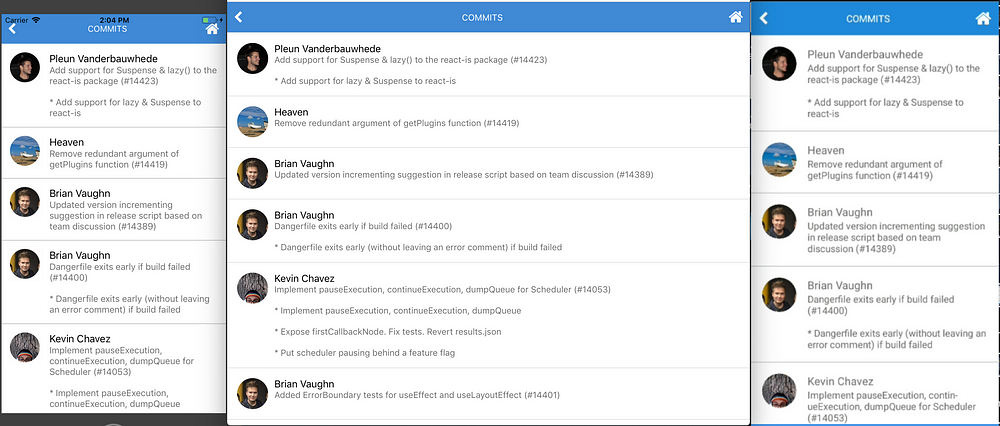
- Initialize the project using CRNWA
- Make sure everything works: Android, iOS and Web
- Add RNE latest ( 1.0.0-beta7 ) to the projection
- Add together 2 screens
Screen i RNE components:
- Input
- Push button with Icon
Screen 2 RNE components:
- Header
- ListItem
- Avatar
- Text
gitphone should accept:
- routing, react-router. It works great both on Native and Web.
- calls to GitHub API. See https://developer.github.com/v3/.
Install create-react-native-web-app
$ npm i - g create - react - native - web - app
Create gitphone project.
λ create - react - native - web - app gitphone
⏳ Creating React Native Web App by the name of gitphone ...
✅ Created project folder .
✅ Added projection files .
⏳ Installing project dependencies ...
yarn install v1 . ten.1
[ i / 4 ] Resolving packages ...
[ 2 / 4 ] Fetching packages ...
info fsevents @ ane .2 .4 : The platform "win32" is incompatible with this module .
info "fsevents@ane.2.4" is an optional dependency and failed compatibility check . Excluding it from installation .
[ 3 / 4 ] Linking dependencies ...
[ 4 / 4 ] Building fresh packages ...
success Saved lockfile .
Washed in 797 . 66s .
✅ Installed project dependencies .
✅ Done ! 😁👍 Your project is ready for evolution .
* change directory to your new project
$ cd gitphone
$ So run the these commands to get started :
* To run evolution Web server
$ yarn spider web
* To run Android on continued device ( after installing Android Debug Span "adb" - https : / / developer . android . com / studio / releases / platform - tools )
$ yarn android
* To run ios simulator ( after installing Xcode - just on Apple devices )
$ yarn ios
* To run tests for Native and Web
$ yarn examination
* To run build for Web
$ yarn build
Alter to gitphone directory and test the spider web app by running yarn web.
                                                      Starting                                          the development server                    ...
                                                                            Compiled                                          successfully                    !
                                                                            Yous                                          can at present view create                    -                    react                    -                    native                    -                    spider web                    -                    app                                        in                                          the browser                    .
                                                                            Local                    :                                          http                    :                    /                    /                    localhost:3001                    /
                                                                            On                                                            Your                                                            Network                    :                                          http                    :                    /                    /                    172.26.235.145:3001                    /
                                                                            Note                                          that the development build                                        is                                          not optimized                    .
                                                                            To                                          create a production build                    ,                                          employ yarn build                    .
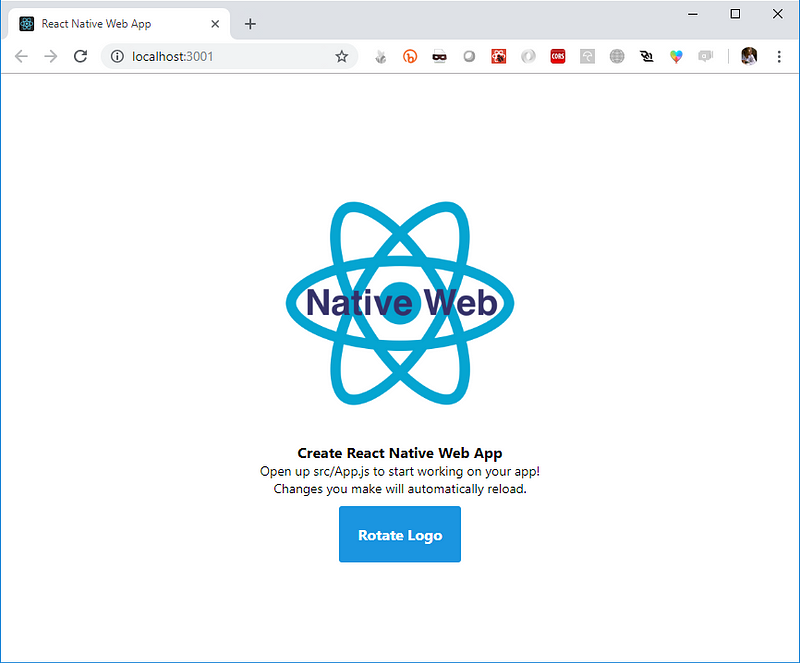
Now, test the gitphone android app by running yarn android.
                                                      Installing                                                            APK                                                            'app-debug.apk'                                          on                                        'Redmi 4X - seven.ane.2'                                                            for                                          app                    :                    debug
                                                                            Installed                                          on                                        1                                          device                    .

                                                                            BUILD                                                            SUCCESSFUL

                                                                            Total                                          time                    :                                                            21.783                                          secs

                                                                            Starting                    :                                                            Intent                                                            {                                          cmp                    =                    com                    .                    creaternwapp                    /                    .                    MainActivity                                                            }
                                                        ✨                                        Washed                                                            in                                                            25                    .                    64s                    .
If the build successful, yous'll see the app installed on your Android (emulator) device.
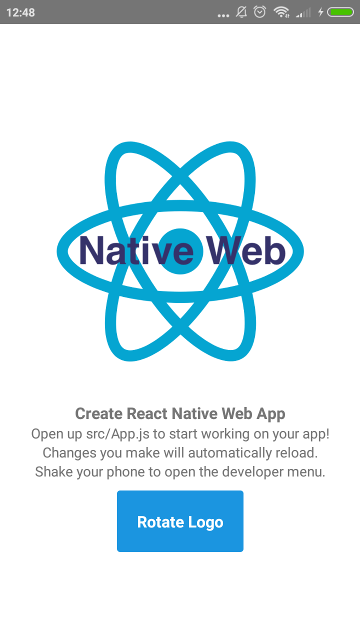
But if y'all got an mistake when run yarn android, please see Troubleshooting section below.
The terminal function for Commencement Step, make sure it tin can be run on iOS without any problem. Run yarn ios and voila!
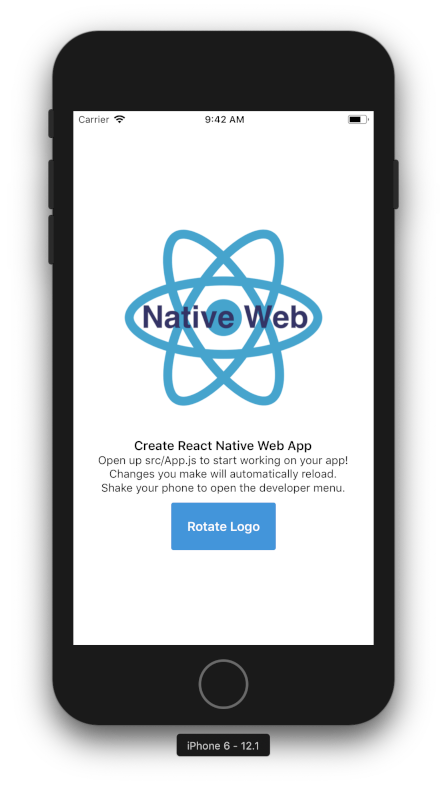
Installing React Native Elements (RNE).
$ yarn add react - native - elements @ beta
Installing React Native Vector Icons (RNVI).
$ yarn add react - native - vector - icons
Linking:
$ react - native link react - native - vector - icons
Both RNE and RNVI are written using es6. If you run yarn web at this point, yous'll got an error.
                                                      .                    /                    node_modules                    /                    react                    -                    native                    -                    elements                    /                    src                    /                    config                    /                    withTheme                    .                    js
                                                                            Module                                          parse failed                    :                                                            Unexpected                                                            token                                                            (                    12                    :                    28                    )
                                                                            You                                          may need an appropriate loader to handle                                        this                                          file type                    .
Nosotros need to tell webpack to transpile them.
- Open
config/webpack.config.dev.js - On line 141
Process JS with boom-boom, add RNE and RNVI to include - Do the same for
config/webpack.config.prod.jsas well 👌
If you become lost, meet this gist or commit 8c0e603.
At present, let's grasp the idea how RNE works.
-
Open src/App.js
-
Import Button from RNE
import { Button } from 'react-native-elements' ;
-
On render, change TouchableHighlight to apply RNE'due south Button
-
Run yarn ios, yarn android and yarn web to see it in action! 👏
Notation: If yous got an error Could not discover com.android.tools.build.appt2 when running yarn android, add google on the gradle repositories.
See this gist or commit for the details: a2ebba1.
Our first component will exist Dwelling. On this component, at that place are two input fields and one Submit push.
- Inside
src, create new folder:Components - Add new file called
Habitation.jsgist - On
App.js, importDomicilecomponent gist - Run
yarn ios,yarn androidandyarn webto see information technology in activity! 🎇
Styling for Abode component
You should notice that our Home doesn't look good in term of UI. Let's add together styling for it.
- Inside
Components, createShared.way.jsfile gist - Import the manner and update
Homecomponent as below gist - Looks meliorate now * , commit for calculation Home component: 2e510c4.
Wait a minute… * Seems there is a problem with RNVI on the web version. You can check this Web (with webpack) commodity or merely following steps bellow.
- Open up
config/webpack.config.dev.js - Add url-loader on line 162 gist
- Do the same for
config/webpack.config.prod.jsequally well 👌 - Open
src/index.jsfile - Add
iconFontand appendmodeto document's head gist
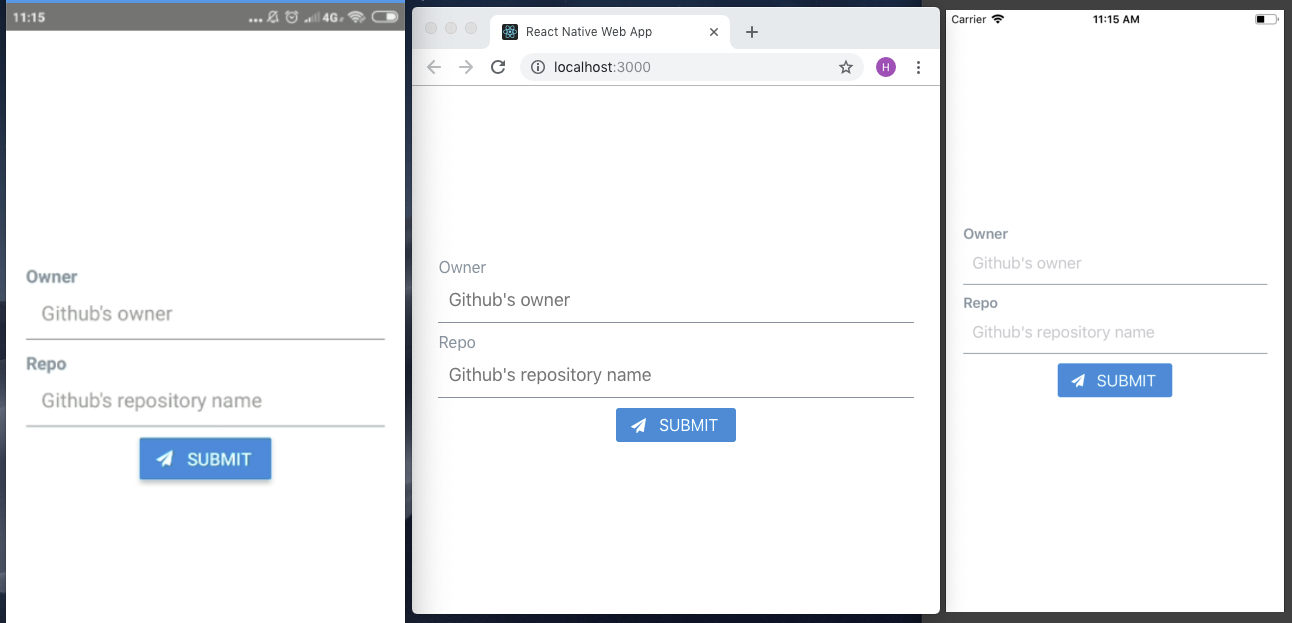 Our RNE x RNW progress so far~
Adjacent, let's add together second component: CommitList.
- Create new folder inside
ComponentsnamedCommit - Add new file:
CommitList.jsgist
On our app, user goes to 2d screen by click on Submit button. How do nosotros implement it?
"react-router comes to the rescue" - https://reacttraining.com/react-router/
Add react-router-dom and react-router-native
$ yarn add react - router - dom react - router - native
Web needs BrowserRouter while native NativeRouter. We need to separate information technology based on the platform.
- On
src, createUtilsbinder - Add together two files on
Utils:Routing.native.jsandRouting.web.jsgist
Those file's content differ merely on the second line. gist
Now, glue it together.
-
Open
App.js, importCommitListcomponent -
Import
Route,RouterandSwitchfromUtils/Routing -
Implement routing inside
rendermethod gist -
Now for the action on
Submitbutton, openDwelling house.js -
Import
withRouterfromUtils/Routingimport { withRouter } from '../Utils/Routing' ;
-
WithRouteris an HOC. Use it to wrapHomecomponentexport default withRouter ( Home ) ;
-
Add
onPressholding for the buttononPress = { this . onPressButton }
-
Implement the
onPressButtonissue handleronPressButton = ( ) => this . props . history . push ( '/commit' ) ;
-
All
Hometogether gist | commit
Test it on web and android, you should be able to go dorsum and forth betwixt screens using Submit and pressing Back push button.
"How tin can I go back on iOS?" 😂
Nosotros will create a withHeader HOC. Why HOC? Nosotros can reuse it easier if nosotros add together more than screens later.
-
On
src, createHOCsfolder -
Add together
withHeader.jsfile -
Import
Headerfrom RNE andIconfromRNVI/FontAwesomeimport { Header } from 'react-native-elements' ;
import Icon from 'react-native-vector-icons/FontAwesome' ;
-
withHeaderaccepts one prop:titleconst withHeader = ( { championship = '' } ) => ( WrappedComponent ) => {
-
Upshot handler to go back / go dwelling house
                                                                  goBack                                                                        =                                                                        (                        )                                                                        =>                                                                        this                        .                        props                        .                        history                        .                        goBack                        (                        )                        ;

                                                                                            goHome                                                                        =                                                                        (                        )                                                                        =>                                                                        this                        .                        props                        .                        history                        .                        replace                        (                        '/'                        )                        ;
-
Import and use
withHeaderinCommitListcomponent gist | commit
Let's fetch a real-alive information: list commit on repository by GitHub and render it on our second screen, CommitList.
Get / repos / : owner / : repo / commits
Ideally, the :owner and :repo are form values from our start screen. Since the objective of this article is RNE x RNW, talk about that grade (and state-management) later on.
To fetch GitHub API, nosotros will use fetch-hoc bundle and too need etch from redux, to handle multiple HOCs on the same component.
$ yarn add fetch - hoc redux
-
Open up
CommitList.js -
Import
{ compose }fromreduxandfetchfromfetch-hoc -
Use it as below gist | commit
Now run yarn spider web, open network tab of DevTools and click Submit button, you'll see bunch of commit data. Past default GitHub API returning 30 commits.
Render commit information
Commit information that will exist displayed on the screen:
                                                      author                    .                    avatar_url

                                                        commit                    :
                                                                              author                    .                    name
                                                                              message
Let'due south modify CommitList.js
-
Add new imports
                                                                  import                                                                        {                                                                        ActivityIndicator                        ,                                                                        Dimensions                        ,                                                                        FlatList                        ,                                                                        Platform                        ,                                                                        View                                                                        }                                                                        from                                                                        'react-native'                        ;
                                                                                            import                                                                        {                                                                        Avatar                        ,                                                                        ListItem                                                                        }                                                                        from                                                                        'react-native-elements'                        ;
-
On master render, modify information technology equally below
                                                                  <                        View                                                  style                        =                        {                        styles                        .                        container                        }                        >
                                                                                                                    {                        this                        .                        renderContent                        (                        )                        }
                                                                                            <                        /                        View                        >
-
Create
renderContentmethodrenderContent = ( ) => (
this . props . loading ?
< ActivityIndicator color = '#87ceeb' / > :
< FlatList
keyExtractor = { this . keyExtractor }
data = { this . props . data }
renderItem = { this . renderItem }
/ >
)
-
Create
renderItemmethodrenderItem = ( { particular } ) => (
< ListItem
title = { item . commit . author . proper name }
subtitle = { item . commit . message }
leftElement = { this . renderLeftElement ( item )
/ >
)
-
Create
renderLeftElementmethodrenderLeftElement = ( item ) => (
< View >
< Avatar
source = { { uri : item . author . avatar_url } }
size = 'medium'
rounded
/ >
< / View >
)
-
Here is our new
CommitListincluding the styling to make it prettier gist | commit
Hither they are!
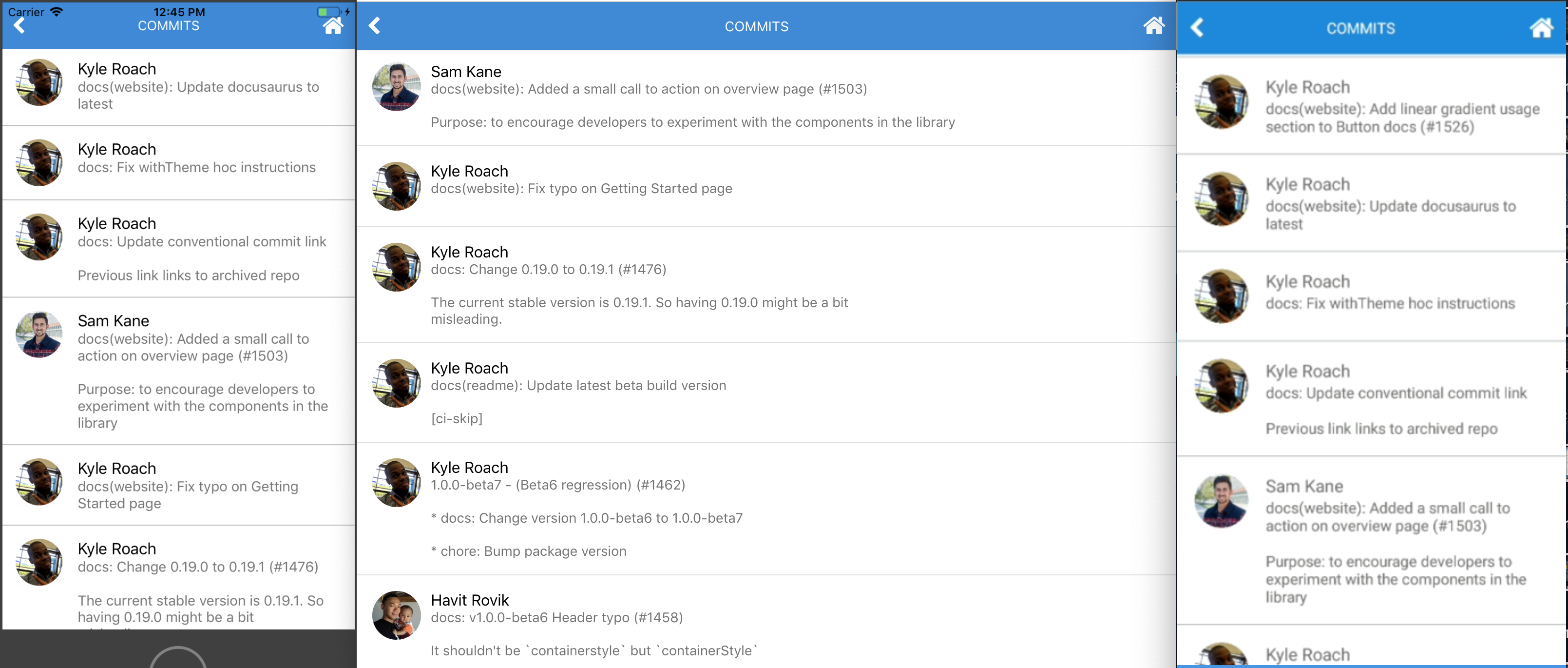 awesome, eh?
Our app looks great so far. Only we are not passing values from showtime to 2nd screen. Let'south do information technology.
-
To handle form, we'll utilise formik
-
Open up
Home.jsand import itimport { Formik } from 'formik' ;
-
Wrap chief
Viewwithformik< Formik initialValues = { { owner : '' , repo : '' } }
onSubmit = { this . onPressButton } >
{ ( { handleChange , handleSubmit , values } ) => (
< View style = { styles . container } >
-
Add
onChangeTexthandler to theInput< Input ... onChangeText = { handleChange ( 'owner' ) } value = { values . owner }
< Input ... onChangeText = { handleChange ( 'repo' ) } value = { values . repo }
-
Alter
ButtononPressprops tohandleSubmit< Button ... onPress = { handleSubmit }
-
Don't forget to close the chief
View
Form submission: done 👌 Next question: How practise we pass these values to second screen? Ship them when we redirect to 2d screen!
-
Inside
onPressButtonmethod, transport an object instead ofpathnameonly.this . props . history . button ( {
pathname : '/commit' ,
state : { owner , repo }
} ) ;
-
Open
CommitList, importwithRouterimport { withRouter } from '../../Utils/Routing' ;
-
Add
withRouterinsidecompose -
Get the values passed down to
withRouterand employ it tofetchwithHeader ( { title : 'Commits' } ) ,
withRouter ,
fetch ( ( { location : { state = { } } } ) => (
` https://api.github.com/repos/ ${ state . owner } / ${ country . repo } /commits `
) )
HOC's order does matter. So, brand sure information technology the same every bit snippet above. In example you lost, here is the commit: 1d83c5e.
Examination the app. Now we should able to fetch any GitHub repository, with some caveats. 👀
What happens if we fetch repository which doesn't be? Red screen on native, bare screen on web! 😹
fetch-hoc returns an fault if information technology has. Let's employ it.
-
On
CommitList, modifyrenderContentthis . props . loading ?
< ActivityIndicator color = '#87ceeb' / > :
this . renderFlatList ( )
-
Import
Textfrom RNEimport { ... , Text } from 'react-native-elements' ;
-
Add
renderFlatListmethodthis . props . error ?
< Text h4 > Error : { this . props . information . message || '😕' } < / Text > :
< FlatList ... / >
Exam it. Instead of red or blank screen, now Error: Not Found displayed.
What'southward else? Attempt to fetch facebook/react-native. We got another error 🙀
Cannot read property 'avatar_url' of null
Non all of writer have avatar_url. We should do this for the Avatar source.
source = { { uri : ( item . writer && item . author . avatar_url ) || undefined } }
So, our app renders nothing if it has no url? It doesn't await good. Solution: return author initial name.
With the help of RegEx and Avatar title props, renderLeftElement should wait similar this now:
                                                      renderLeftElement                                                            =                                                            (                    item                    )                                                            =>                                                            {
                                                                                                const                                          initials                                        =                                          item                    .                    commit                    .                    author                    .                    name                    .                    friction match                    (                    /                    \b\w                    /                    g                    )                                                            ||                                                            [                    ]                    ;

                                                                            render                                                            (
                                                                                                <                    View                                          style                    =                    {                    leftElementStyle                    }                    >
                                                                                                <                    Avatar
                                                                              title                    =                    {                    (                    (                    initials                    .                    shift                    (                    )                                                            ||                                                            ''                    )                                                            +                                                            (                    initials                    .                    pop                    (                    )                                                            ||                                                            ''                    )                    )                    }
                                                                                                ...
Commit for Polishing the app section: 943974b.
When I wrote this, fetch facebook/react-native returning post-obit:
.](https://cdn-images-1.medium.com/max/3812/1*OYTvJP0RLLQemyT0ukb1Iw.png) Why no dearest for regex? Thanks to Sanoor.
Why no dearest for regex? Thanks to Sanoor.
Nosotros have created a simple app using RNE + RNW 👏
-
Works cracking on iOS, web and android? ✅
-
Use components from react-native-elements? ✅
-
Motility between screens? ✅
-
API calls? ✅
Some improvements for gitphone:
If y'all go dorsum from Commits screen, input class on Abode screen are empty. If you lot want preserve previous values, this can be fixed hands by introducing redux to the app. References here: 48108dd.
Tin can we fetch more commits information once nosotros reach the virtually lesser of the list? Space curlicue?
For web, nosotros tin use react-visibility-sensor. Bank check it out: 6c1f689.
For native, it's easier. We can apply FlatList onEndReached props. To give yous an idea how, see this: 9d2e1f2.
#1 Build failed when running yarn android
                                                      :                    app                    :                    compileDebugAidl                                        FAILED

                                                                            FAILURE                    :                                                            Build                                          failed                                        with                                          an exception                    .

                                                                            *                                                            What                                          went wrong                    :
                                                                            Execution                                          failed                                        for                                          job                                        ':app:compileDebugAidl'                    .
                                                                            >                                          coffee                    .                    lang                    .                    IllegalStateException                    :                                          aidl                                        is                                          missing

                                                                            *                                                            Try                    :
                                                                            Run                                                            with                                                            --                    stacktrace option to                                        get                                          the stack trace                    .                                                            Run                                                            with                                                            --                    info or                                        --                    debug choice to                                        go                                          more log output                    .

                                                                            BUILD                                                            FAILED
Here is how to fix #1:
- Open Android Studio.
- Open
androidproject undergitphone.
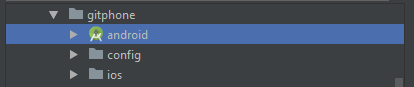
- Click Update on this prompt.
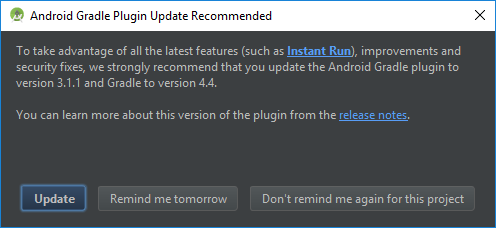
Expect for Android Studio syncing the projection.
- Information technology synced successfully with ii errors.
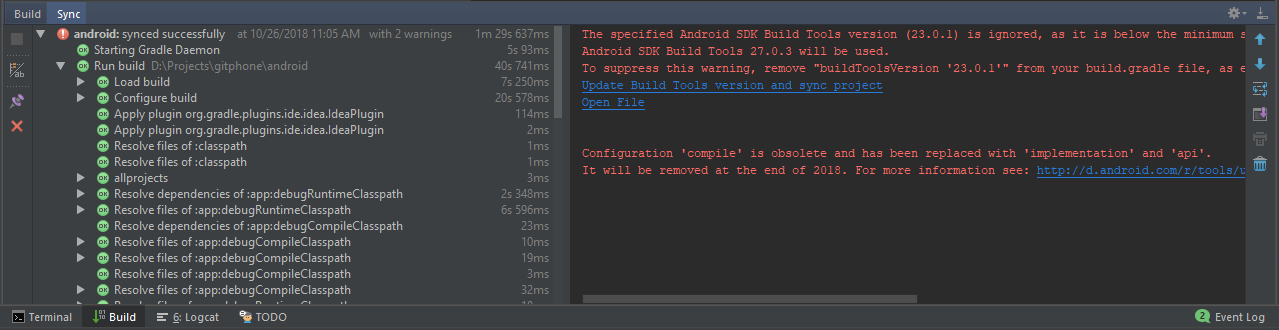
-
At this stage, only click
Update Build Tools version and sync projecton the sync window. -
Now, the remaining warning is the
Configuration 'compile'... -
To set that, open
app/build.gradlefile, changedependenciessection (line 139) to useimplementationinstead ofcompile.dependencies { implementation fileTree(dir: "libs", include: ["*.jar"] ) implementation "com.android.support:appcompat-v7:23.0.ane" implementation "com.facebook.react:react-native:+" }
-
Sync it once more and close Android Studio.

Troubleshooting for android is washed. Now, you should be able to run yarn android successfully.
#2 Build failed when running yarn ios
                                                      **                                                            BUILD                                                            FAILED                                                            **

                                                                            The                                          following build commands failed                    :

                                                                                                CompileC                                                            /                    gitphone                    /                    ios                    /                    build                    /                    Build                    /                    Intermediates                    .                    noindex                    /                    React                    .                    build                    /                    Debug                    -                    iphonesimulator                    /                    double                    -                    conversion                    .                    build                    /                    Objects                    -                    normal                    /                    x86_64                    /                    strtod                    .                    o                                                            /                    gitphone                    /                    node_modules                    /                    react                    -                    native                    /                    third                    -                    party                    /                    double                    -                    conversion                    -                    1.one                    .five                    /                    src                    /                    strtod                    .                    cc                                          normal x86_64 c                    ++                                          com                    .                    apple                    .                    compilers                    .                    llvm                    .                    clang                    .                    1_0                    .                    compiler
Here is how to fix #2:
Inside the project, run script below from your favourite concluding
$ curl - L https : / / gist . githubusercontent . com / fiznool / 739b8e592596b5731512edfd77a1a2e9 / raw / e0123e0b2382e127f1cfd6e28228315f1299738f / set up - rn - xcode10 . sh | bash
If you run yarn ios over again, and you lot got this fault
                                                      The                                          following build commands failed                    :
                                                                                                Libtool                                                            /                    gitphone                    /                    ios                    /                    build                    /                    Build                    /                    Products                    /                    Debug                    -                    iphonesimulator                    /                    libRCTWebSocket                    .                    a                                          normal                                        x86_64
                                                                            (                    1                                          failure                    )
Delight run this script:
$ cp ios / build / Build / Products / Debug - iphonesimulator / libfishhook . a node_modules / react - native / Libraries / WebSocket
Troubleshooting for iOS is done. Now, you should exist able to run yarn ios successfully.
Authors
- haruelrovix
- andangrd
Source: https://reactnativeelements.com/blog
0 Response to "Server Error Cannot Load the Stats for Reactnativeelements – Please Try Again Later"
Mag-post ng isang Komento